28 NOVEMBER 2025
Sound Reduction Through the New Acoustic Approach to Glass

When glass stops being passive and begins to listen, perceive, and react.
In an era where cities are becoming denser and human activity is accelerating, noise has become the new invisible pollutant. At the same time, architecture demands increasingly larger transparent surfaces, calling for light, clarity, and unobstructed views — elements that have traditionally conflicted with sound reduction.
And yet, two technologies are now challenging this limitation.
Not by increasing thickness.
Not by adding weight.
But by changing the very way we perceive the acoustic behavior of glass.
Nano-Engineered Acoustic PVB Interlayers
Active Noise Control (ANC) in Glass Structures
1. Nano-Engineered Acoustic PVB – Reducing the Coincidence Dip
Sound reduction in glass systems has advanced significantly in recent years. However, the real “revolution” isn’t in the thickness of the glass pane, but in a material long considered a given: the PVB interlayer (Polyvinyl Butyral).
Today, the new generation of nano-engineered acoustic PVB radically changes how glass responds to sound.
This PVB features:
- nano-structured composition
- enhanced damping
- targeted viscoelastic behavior
Every glass has a frequency at which its sound insulation suddenly drops: the coincidence frequency.
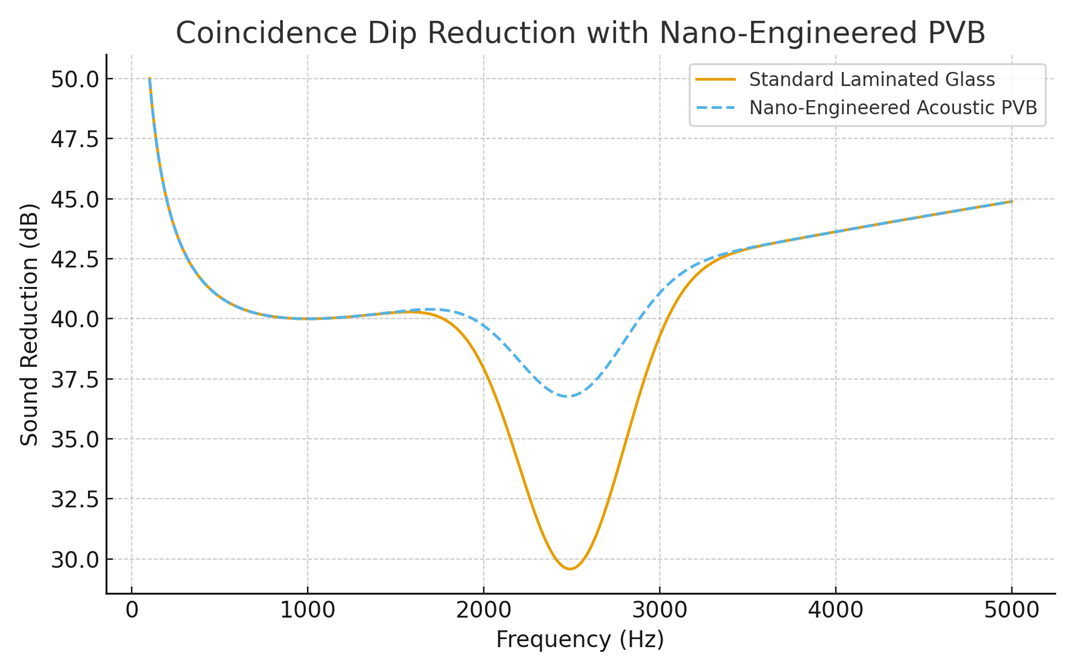
Diagram: Reduction of the Coincidence Dip
What we observe:
- Standard laminated glass shows a sharp drop around ~2,500 Hz (orange line).
- Nano-engineered PVB reduces this dip by up to 60%, smoothing the curve and offering more stable acoustic performance (blue line).
This is important because the 1,000–3,000 Hz range is the most critical for human speech, urban traffic, road noise, ventilation, and mechanical systems.
Reducing the dip improves the actual quietness we perceive — not just a certified dB number. This is something most people are unaware of, yet it is the primary factor that determines how effective a glass truly is in noise reduction.
How It Works in Practice
Advanced acoustic PVBs feature:
- multi-layer molecular structures
- variable stiffness zones tuned to different frequencies
- enhanced damping efficiency in the 500–2,500 Hz range — exactly where traffic and human voice dominate
The result is a laminated glass that is thinner, lighter, and offers more consistent noise reduction in real-world conditions.
Nano-engineered acoustic PVB interlayers are the most advanced passive solution for sound reduction in glass today.
They bring soundproofing technology from “mass-based” to “material-structured,” transforming laminated glass into a sophisticated, frequency-tuned system.
2. Active Noise Control (ANC) in Glass Surfaces – The Future of Sound Reduction
Traditional passive sound reduction in glass has limits: thickness, weight, and physical damping. To address modern urban noise, engineers are developing an entirely new approach: Active Noise Control (ANC) for windows and façades.
This technology was once found only in high-end headphones — today, it is being applied to glazing.
What Is Active Noise Control?
ANC works on the principle of anti-phase sound cancellation:
An inverse sound wave is generated to cancel out the incoming noise.
In glass applications, the system includes:
- micro-sensors that detect vibrations on the glass pane
- edge-mounted micro-speakers that generate anti-noise
- AI-based signal processors that calculate the correct phase in real time
It can be installed within the frame, the perimeter profile, or even on the glass surface itself (in advanced prototypes).
Here, the glass acts as the medium that transmits the sound to the ANC system.
This enables:
- noise reduction at low frequencies (50–500 Hz), where glass performs poorly on its own
- active suppression of:
traffic noise, engines, bass frequencies
- consistent performance regardless of glass thickness
The most impressive part: ANC works complementarily with passive sound reduction. It does not replace it — it strengthens it exactly where passive glass is weakest.
The diagram shows how ANC actively cancels incoming noise and performs best at low frequencies — the most challenging range for glass.
Advanced ANC systems use:
- adaptive FIR filters
- neural estimation models
- predictive algorithms for patterned noise (e.g., traffic patterns)
This allows the system to adapt to the space and the geometry of the window.
Power consumption in tested prototypes is remarkably low (1–2 W on average), with auto-sleep modes and compatibility with smart home systems.
Where Will We See It Soon?
- luxury residences in high-noise cities
- premium hotels
- hospitals
- offices adjacent to major roads
- airports, stations, major infrastructures
It is already being piloted in several R&D projects.
Active Noise Control in glass is perhaps the most significant technological advancement in fenestration since the introduction of low-e coatings.
It does not rely on mass or thickness — but on digital signal processing.
It paves the way for glazing that “learns” and adapts to its environment.
The Future of Sound Reduction Is the Combination of Both Technologies
- Nano-Engineered PVB smooths mid & high frequencies (1–4 kHz)
- Active Noise Control targets the low spectrum (50–500 Hz)
Together, they offer:
- superior overall quietness
- stable performance across temperatures
- lighter constructions
- smaller thickness requirements
- improved energy efficiency
This combination is already considered the acoustic glazing system of the future.
Written by Giannis Tsoumos
MEng, MSc, MBA — Business Operations Manager, Yalodomi
Related News

14 January 2026
Trust Has a Name Teaser: Yalodomi presents the AspisLam Series: an advanced armored glass solution engineered for top-tier ballistic and anti-burglary protection. With decades of expertise and specialized know-how, Yalodomi...
14 January 2026
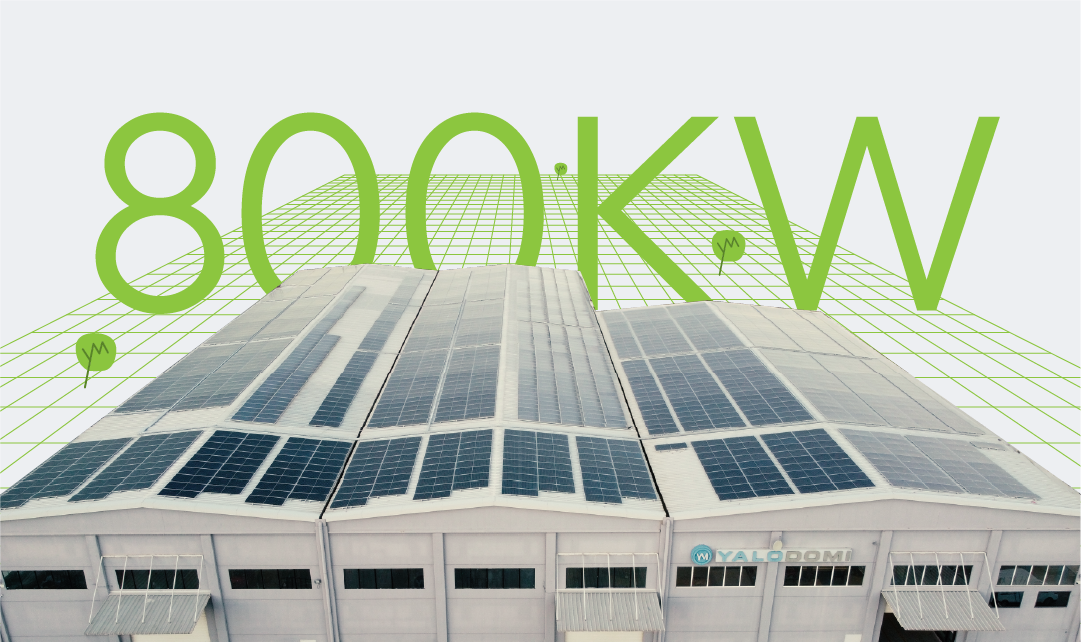
Powering the Future with Clean Energy At Yalodomi, innovation is not limited to our products or construction services it is part of our mindset. With this philosophy, we developed a...

14 January 2026